A backyard play area is often planned around what children enjoy at one particular age. A small slide may be perfect for a preschooler, while a basic swing can keep a young child entertained for hours. The difficulty is that children’s interests, abilities and confidence can change quickly.
A play space that works well over several years needs more than a collection of equipment. It should provide different levels of physical challenge, allow room for imaginative play and remain practical as children become taller, stronger and more independent.
Thoughtful planning can help families create a backyard that continues to feel engaging without requiring a complete redesign every few years.
Begin With the Way the Backyard Is Already Used
Before choosing equipment, consider how the family currently uses the outdoor area.
Some backyards are mainly active spaces where children run, climb and play games. Others are shared with outdoor dining, gardening, pets or entertaining. The play zone should fit naturally into these existing routines rather than taking over the entire yard.
Observe where children tend to gather and which areas receive comfortable shade during the times they usually play. Also consider how adults will supervise the space from the kitchen, living room or outdoor seating area.
Useful planning questions include:
- Which parts of the yard must remain open?
- Where can children play without crossing driveways or service areas?
- Can the equipment be seen from commonly used rooms?
- Is there enough space for safe movement around the structure?
- Will the area interfere with entertaining, gardening or pets?
A well-positioned play area is more likely to be used regularly because it becomes part of everyday family life.
Create Different Types of Play Within One Area
Children rarely want to use outdoor equipment in only one way. A structure may become an obstacle course one day, a pretend fort the next and a meeting place for friends on the weekend.
The most useful play spaces provide opportunities for several kinds of activity:
- Climbing and hanging
- Swinging or suspended movement
- Balancing and jumping
- Imaginative games
- Quiet rest between active play
- Social play with siblings and friends
Not every feature must be installed immediately. The initial design can provide a strong base with enough surrounding space for future additions.
Open-ended equipment tends to remain interesting longer because children can invent their own challenges instead of following one fixed activity.
Plan for Changes in Height and Ability
A structure designed only for a small child may become too easy within a short period. At the same time, equipment that is too difficult can discourage younger users or increase the likelihood of unsafe improvisation.
An adaptable space allows challenge to increase gradually. This might involve changing the height of certain components, adding more complex climbing accessories or creating new routes through the play area.
Siblings of different ages may also need separate levels of difficulty. A younger child may use lower steps and basic swings, while an older child attempts hanging, balancing or obstacle-based activities.
The aim is not to remove all difficulty. Appropriate physical challenges help children test their abilities and build confidence. The design should simply allow those challenges to develop at a manageable pace.
Choose a Strong Foundation for Future Additions
Families often focus on the number of accessories included with a play structure, but the main frame deserves equal attention. A strong and flexible base can support changes as children develop new interests.
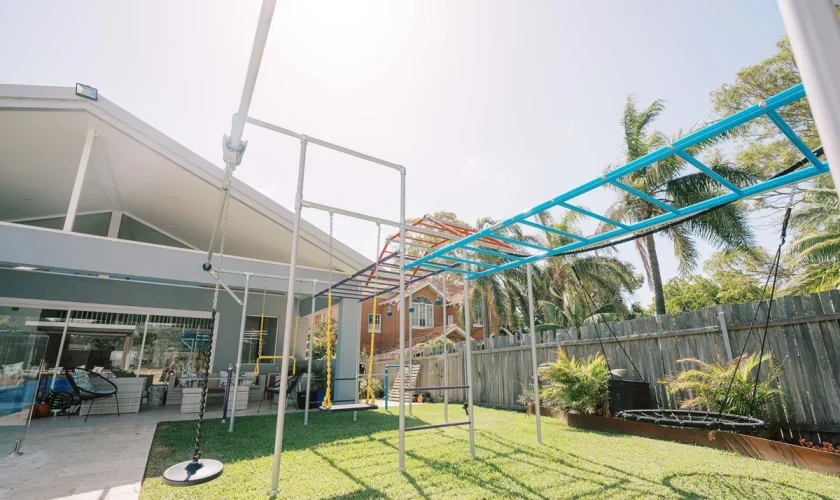
When comparing backyard options, parents may consider Monkey Bars as part of a broader play zone that can incorporate climbing challenges, swings, hanging activities and imaginative games.
The structure should be assessed according to the available yard, the ages of the children and how the family expects to use it over time. A larger setup is not automatically better if it leaves insufficient room for movement or dominates the outdoor area.
A more carefully selected frame with the ability to accept later additions may offer greater long-term usefulness than a crowded structure with features children quickly outgrow.
Allow Enough Space Around the Equipment
The footprint of the equipment is only part of the space requirement. Children need clear areas around climbing points, swings, slides and other moving components.
A swing requires unobstructed space in front and behind it. Climbing areas need suitable fall zones. Entry and exit points should not direct children into fences, furniture or garden features.
The play area should also remain separate from hazards such as:
- Barbecues and outdoor kitchens
- Clotheslines
- Swimming pools
- Garden tools and chemicals
- Vehicle access
- Retaining walls
- Low branches or overhead cables
Accurate measurements should be taken before purchase. Estimating the space by eye can lead to an overcrowded layout once the equipment is assembled.
Select an Appropriate Ground Surface
The surface beneath outdoor play equipment affects comfort, drainage, maintenance and the consequences of falls.
Hard paving may be easy to clean but can be unforgiving around climbing structures. Lawn provides a softer appearance, although heavily used sections may become compacted, muddy or worn.
Depending on the design and installation requirements, families may consider impact-absorbing materials intended for outdoor play areas. Whatever surface is chosen should be installed and maintained correctly.
Drainage also matters. Water should not collect around the legs or base of the equipment after rain. Persistent moisture can make the area slippery and reduce how often it can be used.
Make Shade Part of the Design
Australian backyards can become extremely hot, especially during the middle of the day. Metal components, dark surfaces and exposed ground may heat quickly in direct sunlight.
Existing trees, rooflines, shade sails or other structures may help protect part of the play area. Shade should be planned in relation to how the sun moves rather than based on conditions at one time of day.
Parents should still check surface temperatures before play, even when shade is available. Seasonal changes can alter sun exposure, and a location that remains cool in winter may receive intense summer sunlight.
The space should also allow airflow. Fully enclosing the play zone may trap heat and reduce visibility.
Maintain Clear Supervision Lines
Children gradually gain independence, but supervision remains important around climbing and moving equipment.
The play area should be visible from the parts of the home where adults commonly spend time. Tall garden beds, solid screens or storage sheds should not block the entire view.
Good visibility does not require placing the structure directly beside the house. It means adults can check the area without walking around several obstacles.
Lighting may also be useful when children play during late afternoons. Outdoor lights should illuminate paths and boundaries without creating glare.
Include Storage for Loose Equipment
Balls, ropes, sporting equipment and removable accessories can quickly spread across the backyard.
A weather-resistant storage box or small shed keeps these items organised and reduces trip hazards. Storage should be close enough for children to return items themselves, but it should not obstruct the play zone.
Rotating loose toys can also renew interest. Instead of leaving everything available at once, families can introduce different items depending on the season or the children’s current interests.
Build in Opportunities for Family Play
Outdoor equipment does not need to be reserved entirely for children. A play space becomes more valuable when parents and siblings can participate safely.
Families might create timed obstacle challenges, practise throwing and catching, or combine climbing activities with simple backyard games.
Shared play encourages children to remain active and gives adults a chance to model safe equipment use. It also makes the area feel like a family space rather than an isolated children’s corner.
Review the Setup as Children Grow
A backyard play area should not be installed and then forgotten. Children become taller, stronger and more adventurous, while weather and regular use can affect the equipment and ground surface.
Periodic reviews should consider:
- Whether activities remain appropriately challenging
- Whether accessories need adjustment
- Whether bolts and connections remain secure
- Whether the ground surface needs repair
- Whether nearby trees or plants have changed the available space
- Whether younger visitors can use the area safely
The layout may also need to change when children begin using larger sporting equipment or when family priorities shift.
Design for Years of Use, Not One Season
The most successful backyard play spaces balance present enjoyment with future flexibility.
A structure should suit the children who use it today while allowing new challenges to be introduced as their strength and confidence develop. Space, supervision, shade, surfacing and maintenance all contribute to how well the area functions.
By planning the backyard as an adaptable environment rather than a fixed collection of equipment, families can create a play space that remains useful, inviting and engaging through several stages of childhood.